
Cardarine GW-501516 has one of the odder histories of any research compound. It looked promising, was dropped by a major drug company, and is still used in labs every day. This guide explains what Cardarine GW-501516 is, why development stopped, what researchers use it for now, and how to buy it.
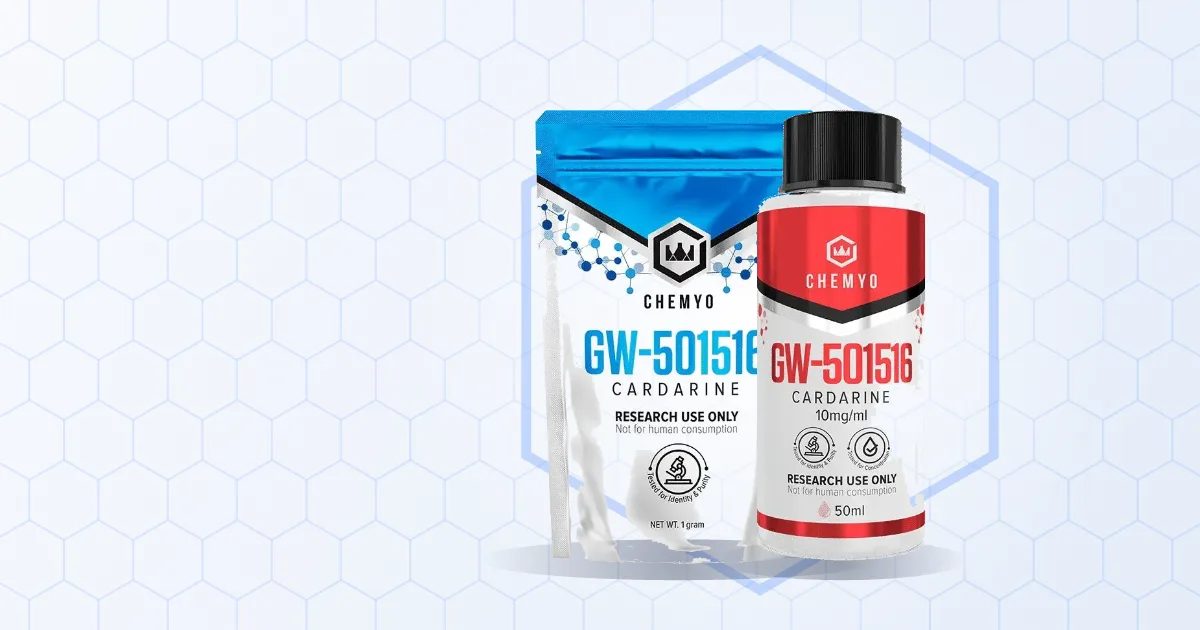
What is Cardarine GW-501516?
Cardarine, coded GW-501516 and sometimes called endurobol, is a selective agonist of PPAR delta (also written PPARβ/δ). PPARs are nuclear receptors that switch on genes involved in how cells handle fat and energy. PPAR delta is especially active in skeletal muscle.
It isn’t a SARM. It doesn’t touch the androgen receptor at all. It’s listed alongside SARMs because researchers often study the two together, and because it shows up in the same online conversations.
The CAS number is 317318-70-0, the formula is C21H18F3NO3S2 and the molar mass is 453.50 g/mol.
Who developed GW-501516
GlaxoSmithKline and Ligand Pharmaceuticals developed Cardarine GW-501516 in the 1990s. The aim was a treatment for metabolic and cardiovascular problems, such as low HDL cholesterol and high blood fats.
A widely cited 2001 study in obese rhesus monkeys reported higher HDL and lower triglycerides. Later mouse work drew even more attention: one 2008 paper described PPAR delta agonists as exercise mimetics, because treated mice could run further, especially when the compound was combined with exercise or with an AMPK activator.
Why GSK stopped development
Around 2007, GSK ended the program. Long-term studies in rodents had found cancers developing in several organs at a range of doses. The compound was never approved, and in 2013 the World Anti-Doping Agency took the unusual step of issuing a specific warning about it.
That history matters if you’re designing a study. Any long-term work with GW-501516 has to take the rodent findings into account. You can read the original papers and the later reviews on PubMed.
What labs use Cardarine for today
Despite the stop, Cardarine GW-501516 is still one of the most selective PPAR delta agonists available, so it’s a standard tool in basic research. Labs use it to study fatty acid oxidation in muscle, mitochondrial gene expression, endurance in animal models and inflammation.
It’s also used as a reference compound when testing newer PPAR delta agonists. Our GW0742 solution is a close structural relative from the same GSK work, and the two are often compared directly.
How PPAR delta signaling works
When an agonist binds PPAR delta, the receptor pairs with another nuclear receptor called RXR. The pair then attaches to specific stretches of DNA. That turns on genes for fatty acid uptake, fat burning in mitochondria and, in muscle, a shift toward slow-twitch fibers that tire less easily.
That’s a very different mechanism from the androgen receptor. It’s also why pairing Cardarine GW-501516 with a SARM makes sense in a study: the two act on separate pathways, so their effects can be measured side by side.
Cardarine compared with other compounds
Next to SR9009, which acts on the Rev-Erb receptors and circadian rhythm, Cardarine GW-501516 is the better-documented metabolic tool. Next to SLU-PP-332, a newer ERR agonist also called an exercise mimetic, it has decades more data. You’ll find all three in our metabolic research compounds section.
Planning research with GW-501516
Our solution is 10mg/ml in 94% PEG 400 and 5% ethanol, so a vehicle control should match both. Divide 10mg/ml by the molar mass and you get about 22 mM, which is a useful number to have in your protocol.
If you’d rather choose your own solvent, the powder is the better fit. Either way, keep the batch number from the label with your data.
Reading the Cardarine GW-501516 lab report
Each certificate comes from an outside lab accredited to ISO/IEC 17025:2017. For the solution, the number to check is the measured concentration in mg/ml against the 10mg/ml on the label. For the powder, look for an identity test and an HPLC purity figure. You’ll find the reports in each product’s image gallery.
Common mistakes with GW-501516 studies
The most common one is forgetting the ethanol. Our solution contains 5% ethanol, and a PEG-only control won’t account for it.
Another is reading too much into the endurance studies. Most of the exercise-mimetic results come from mice, often with specific strains and training protocols, and they don’t always repeat in other models. A third is running long studies without planning for the rodent safety findings mentioned above.
Storing Cardarine GW-501516
Keep the powder sealed in a cool, dry place. Close the solution after every use, since the ethanol slowly evaporates and the concentration can drift upward if the cap is left off. Store both away from direct light, and use a clean 1ml dropper for every draw so nothing gets back into the bottle.
How to buy Cardarine GW-501516 for research
Cardarine at Chemyo Labs
- Cardarine powder, 1g: $40.
- Cardarine solution, 10mg/ml, 50ml: $50, in PEG 400 with 5% ethanol.
- Five SARM stacks pair it with Ostarine, RAD-140, LGD-4033, YK-11 or Andarine.
All of these are in stock. Lab reports are in each product’s image gallery, and our lab testing page explains how to read them.
Cardarine GW-501516 questions
Is Cardarine a SARM?
No. It’s a PPAR delta agonist. It doesn’t act on the androgen receptor.
Why did GSK stop developing it?
Long-term rodent studies found cancers in several organs, and the program ended around 2007.
What is endurobol?
Another name for GW-501516, from its reputation in endurance studies in mice.
What’s the difference between Cardarine and GW0742?
They’re related PPAR delta agonists from GSK. GW0742 has a slightly different structure and is often used to compare against GW-501516.
Ready to order? Buy Cardarine solution or Cardarine powder, or see the full SARM stacks range.
More research guides
MK-677 (ibutamoren): a research guide
What Merck found, how it works on the ghrelin receptor, and how to buy it as powder or liquid.
RAD-140 (testolone): a research guide
Radius Health’s SARM, the preclinical data and the Phase 1 trial, plus our two formats.
Ostarine MK-2866: a research guide
The best documented SARM, from GTx’s trials to choosing powder or solution.
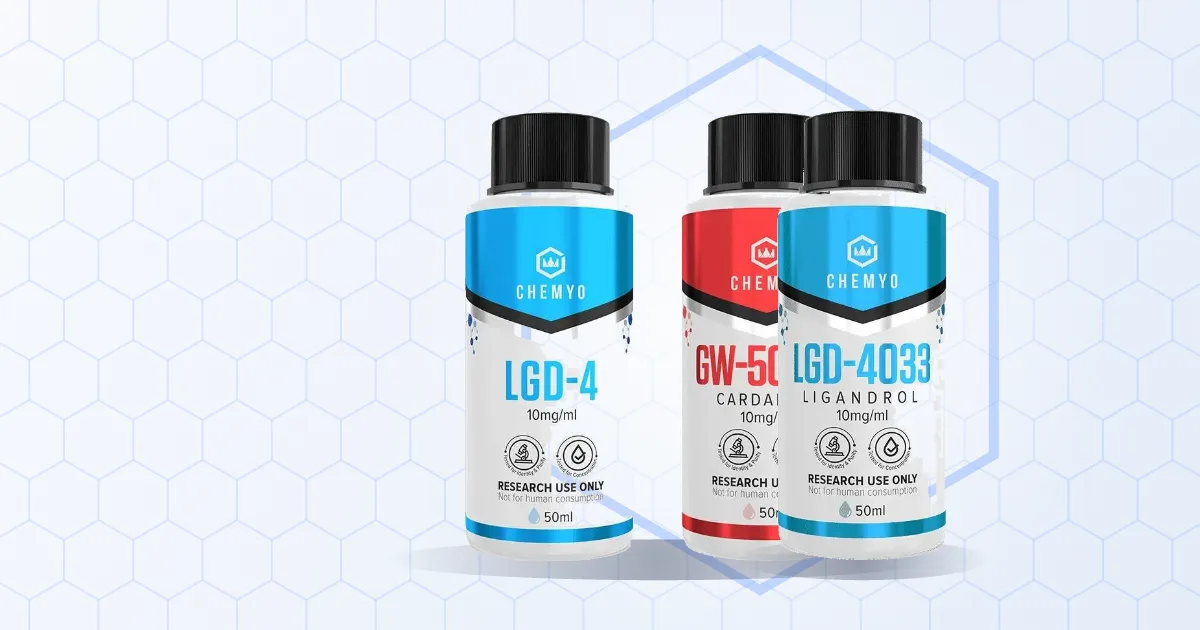
LGD-4033 (ligandrol): a research guide
Ligand’s SARM, the 2013 Phase I study and how our solution is made up.