
RAD-140 comes up in almost every conversation about newer SARMs. This guide explains what RAD-140 is, who developed it, what the preclinical and early clinical work found, and how to buy RAD-140 for research as a powder or a solution.
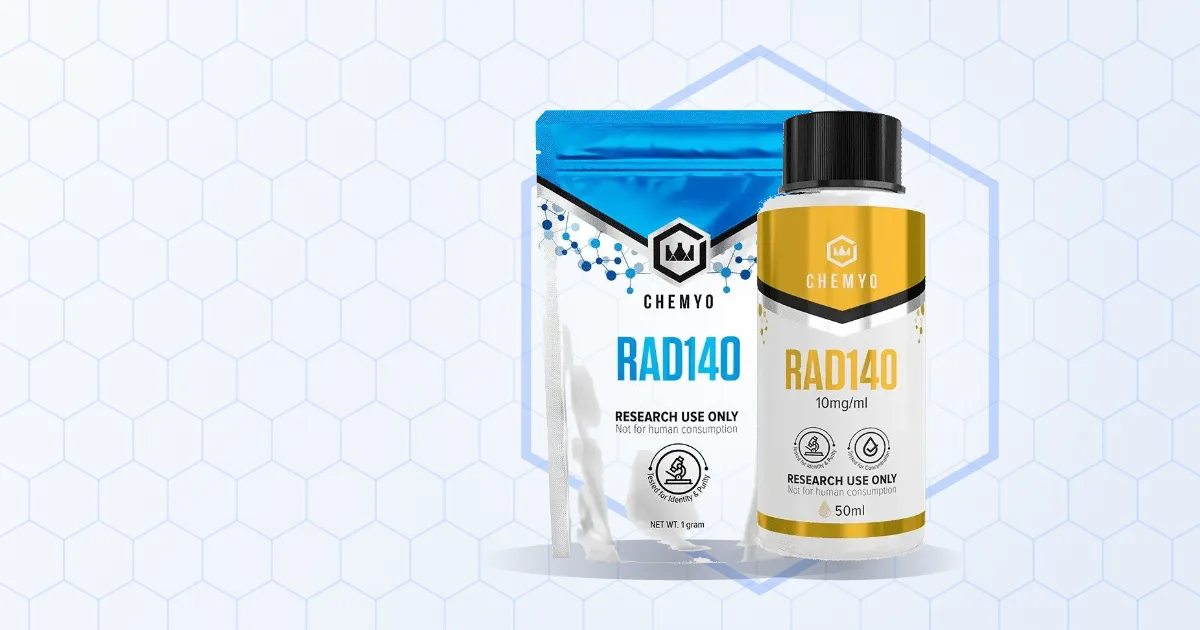
What is RAD-140?
RAD-140, also sold as testolone, is a nonsteroidal selective androgen receptor modulator. Like other SARMs, it binds the androgen receptor, the same receptor testosterone uses. The goal behind the whole class was to get a strong effect in muscle and bone while doing much less in tissues like the prostate.
Its CAS number is 1182367-47-0, the formula is C20H16ClN5O2 and the molar mass is 393.83 g/mol. Those figures are on our product pages too.
Who developed testolone
Radius Health, a Boston biotech company, designed the compound. The first description appeared in 2011 in a paper on its design and preclinical testing. In that work it showed high affinity for the androgen receptor and good oral bioavailability in animals.
Radius was interested in more than muscle. Androgen receptor signaling matters in some breast cancers, and the company later tested the compound in that setting.
What the RAD-140 research looked at
The early papers looked at three tissues: muscle, prostate and the brain. In castrated rats, the compound restored muscle weight at doses that had less effect on the prostate. A study in cynomolgus monkeys reported gains in lean mass over 28 days. Separate work in cultured rat neurons looked at whether it protected cells from stress, which pointed to possible neuroprotective effects.
The one human study is a Phase 1 trial in women with advanced breast cancer that was both estrogen receptor and androgen receptor positive. It was a small dose-finding trial, so it says more about tolerability than about effects. The compound has never been approved for any use.
There’s also a set of published case reports describing liver injury in people who used testolone products bought online. It’s worth reading those alongside the preclinical data. You can find all of it on PubMed.
How SARMs differ from steroids
Testosterone and anabolic steroids are built on the steroid ring structure. In the body, testosterone can be turned into DHT by 5-alpha reductase or into estradiol by aromatase, and both conversions spread its effects into other tissues.
Nonsteroidal SARMs don’t have that ring system, so those enzymes don’t act on them in the same way. The selectivity comes from how the molecule sits in the receptor and which helper proteins it recruits in each tissue. In muscle, the receptor switches on. In the prostate, the response is weaker.
That’s the theory. How well it holds up varies a lot from compound to compound, and it’s one of the main things preclinical papers try to measure.
How potent is it?
In the published animal work, it was more potent than earlier SARMs like Ostarine, meaning lower doses produced comparable effects in animal models. That’s one reason it draws interest. It’s also a reason to be careful with concentration when you prepare solutions, since small measuring errors make a bigger difference with a potent compound.
RAD-140 compared with other SARMs
Ostarine has far more published data, including large human trials. LGD-4033 has a Phase I study in healthy men. Testolone sits between them: more potent than Ostarine in the animal work, with less human data than either.
There’s also an ester, RAD-150 (TLB-150 benzoate), which keeps the same core with a benzoate group attached. Labs sometimes run the two side by side to compare the parent compound with the ester.
Planning research with testolone
Pick your format first. If you need the compound in a specific solvent for an assay, the powder gives you that freedom. If you’d rather work from a fixed concentration, our solution is 10mg/ml in PEG400, so 1ml holds 10mg.
Whatever you choose, run a vehicle-only control. PEG400 has its own effects in some cell and animal models, and you’ll want to rule those out. Record the batch number from the label as well, so you can match results to the right certificate later.
Working out concentrations
The spec table gives you what you need to convert between mass and molar units. Take our solution at 10mg/ml. Divide by the molar mass, 393.83 g/mol, and you get roughly 25.4 mM. If you dilute 1ml into 9ml of vehicle, you’re at about 2.5 mM.
Do this once, carefully, then write it into your protocol. It saves a lot of confusion later. It also makes it obvious if a number in someone else’s paper doesn’t add up.
How to buy RAD-140 for research
RAD-140 at Chemyo Labs
- RAD-140 powder, 1g: $70, dry compound in a sealed container.
- RAD-140 solution, 10mg/ml, 50ml: $70, 1% RAD-140 in 99% PEG400.
- RAD-140 and Cardarine stack: $120, two 50ml bottles plus a pipette.
- RAD-140 and MK-677 stack: $140, two 50ml bottles plus a pipette.
Both single products are in stock, and the lab reports are in each product’s image gallery. Measuring from the solution? Add a few 1ml droppers to your order.
Storing testolone
Keep the powder sealed in a cool, dry place. The solution should stay closed when you’re not drawing from it, out of direct light. Use a clean dropper every time so nothing gets back into the bottle.
RAD-140 questions
Is RAD-140 the same as testolone?
Yes. Testolone is another name for RAD-140.
Who makes RAD-140?
Radius Health developed it. Chemyo Labs sells it as a research chemical in powder and solution form.
Has RAD-140 been approved?
No. It has only been through preclinical studies and a small Phase 1 trial.
What’s the difference between RAD-140 and RAD-150?
RAD-150 is a benzoate ester of RAD-140, with a higher molar mass. We sell both as 1g powders.
Ready to order? Buy RAD-140 solution or RAD-140 powder, or see all our SARMs for sale.
More research guides
MK-677 (ibutamoren): a research guide
What Merck found, how it works on the ghrelin receptor, and how to buy it as powder or liquid.
Ostarine MK-2866: a research guide
The best documented SARM, from GTx’s trials to choosing powder or solution.
Cardarine GW-501516: a research guide
Why GSK dropped it, why labs still use it, and how it pairs with SARMs.
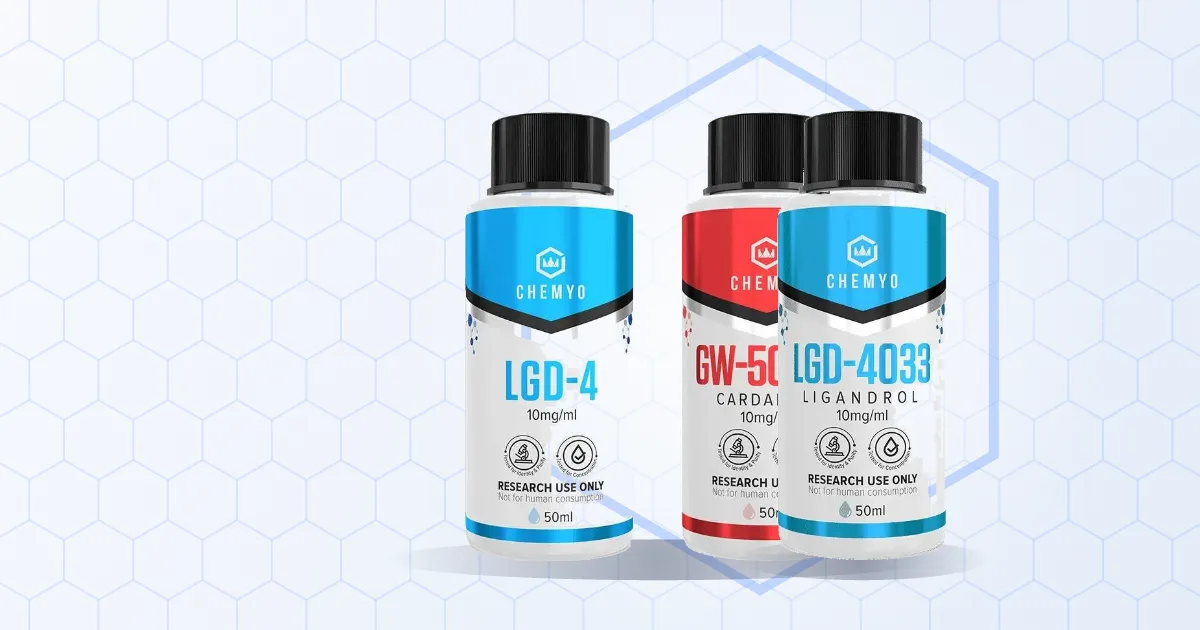
LGD-4033 (ligandrol): a research guide
Ligand’s SARM, the 2013 Phase I study and how our solution is made up.