
LGD-4033 is one of the few SARMs with a published human study in healthy volunteers. This guide covers what LGD-4033 is, who developed it, what that study and later trials found, and how to buy LGD-4033 for research.
What is LGD-4033?
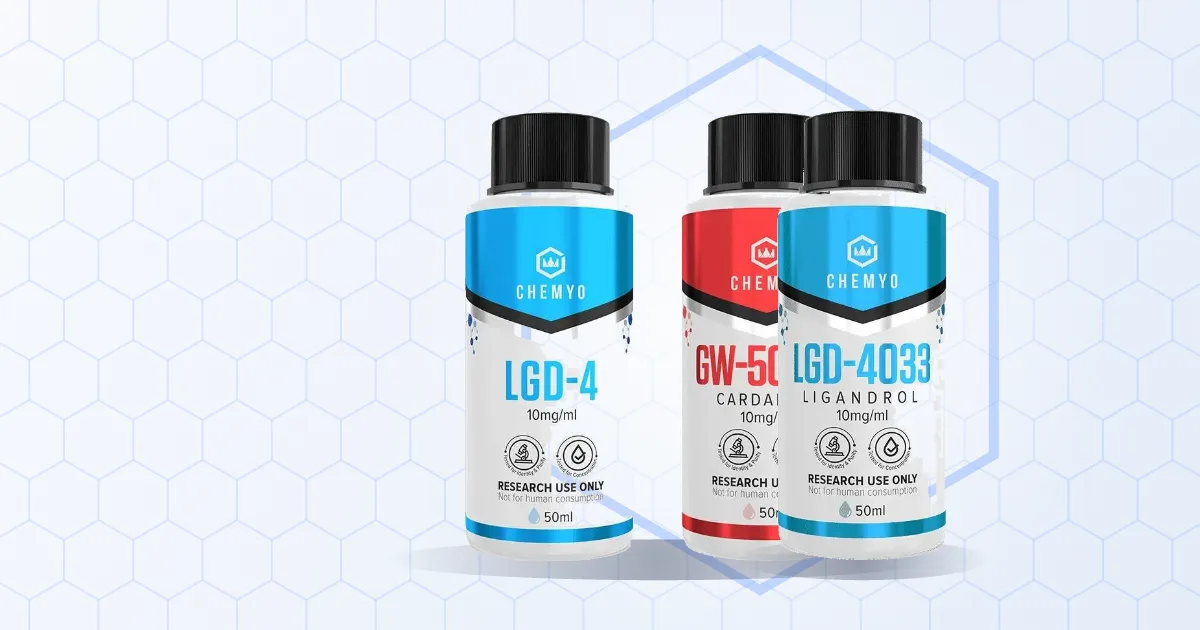
LGD-4033, also known as ligandrol and later as VK5211, is a nonsteroidal selective androgen receptor modulator. It binds the androgen receptor with very high affinity and was designed to act mainly on muscle and bone.
The CAS number is 1165910-22-4, the formula is C14H12F6N2O and the molar mass is 338.25 g/mol. You’ll also see it written as LGD4033, LGD-4 or LGD4.
Who developed ligandrol
Ligand Pharmaceuticals, based in San Diego, developed the compound. Ligand had a long history with nuclear receptors, and it was also GSK’s partner on Cardarine. Viking Therapeutics later licensed ligandrol and renamed it VK5211.
What the LGD-4033 research found
The best-known paper is a Phase I trial published in 2013. Seventy-six healthy young men took one of three doses or a placebo for 21 days. Lean body mass went up in a dose-dependent way. The trial also recorded lower testosterone, SHBG and HDL cholesterol, which mostly returned to normal after the study ended.
Viking then ran a Phase 2 trial in older adults recovering from hip fracture surgery and reported gains in lean body mass in 2017. The compound hasn’t been approved for any use, and like all SARMs it’s on the WADA prohibited list. You can find these papers on PubMed.
Why the human data matters
Most SARMs have only animal data. For ligandrol, there’s a controlled trial with a placebo group, published doses and measured side effects. That makes it much easier to put new results in context, and it’s why it’s a common comparison point in SARM research.
The same trial is also a good reminder that SARMs aren’t free of androgen effects. Hormone levels and blood lipids changed even at low doses and over a short period.
How ligandrol compares with other SARMs
Ostarine has more total human data, including Phase III trials. RAD-140 looks more potent in animal studies but has less human data. Ligandrol sits in the middle: very high receptor affinity, with one well-controlled study in healthy men.
Labs comparing SARMs often run all three. Every one is available from us as a 50ml solution, so you can keep the format the same across the comparison.
How the androgen receptor responds
When a ligand binds the androgen receptor, the receptor moves into the cell nucleus, attaches to DNA and switches on target genes. How strongly that happens depends on the ligand and on which helper proteins are present in that tissue.
High affinity means the compound binds tightly at low concentrations. It doesn’t automatically mean a bigger effect, which is one reason affinity and potency are measured separately in papers.
Planning research with ligandrol
Our solution is 10mg/ml in PEG400. Dividing by the molar mass gives about 29.6 mM. Because the compound is potent, small errors in measuring make a real difference, so a calibrated pipette and a matching PEG400 control are worth the effort.
What our lab report shows
We had our LGD-4033 solution assayed by an outside, ISO/IEC 17025:2017 accredited lab. A bottle labeled 10mg/ml measured 10.6mg/ml by HPLC. The report is in the product’s image gallery.
Why labs pair ligandrol in stacks
A stack here simply means two separate bottles sold together. Nothing is premixed. Pairing a SARM with Cardarine lets a study look at the androgen receptor next to PPAR delta, a fat-metabolism pathway. Pairing it with MK-677 puts it next to the growth hormone axis.
In both cases the two compounds act on different receptors, which is what makes the comparison useful. Each stack includes a 1ml pipette, and the price matches buying the two bottles on their own.
Storing your solution
Keep the bottle closed and out of direct light, in a cool, dry place. Shake it gently before each use so the solution is even. Use a fresh dropper every time, since a dropper that’s been in one bottle can carry traces into the next. That matters most when you’re working from a stack and switching between two compounds in the same session.
How to buy LGD-4033 for research
LGD-4033 at Chemyo Labs
- LGD-4033 solution, 10mg/ml, 50ml: $70, 1% LGD-4033 in 99% PEG400.
- LGD-4033 and Cardarine stack: $120, two 50ml bottles and a pipette.
- LGD-4033 and MK-677 stack: $140, two 50ml bottles and a pipette.
All three are in stock. Measuring from the single bottle? Our sterile 1ml droppers are $1 each.
LGD-4033 questions
Is LGD-4033 the same as ligandrol?
Yes. Ligandrol is another name for LGD-4033, and VK5211 is the code Viking Therapeutics used.
Has LGD-4033 been tested in people?
Yes, in a 2013 Phase I study in healthy men and a later Phase 2 trial in hip fracture patients. It hasn’t been approved.
Do you sell LGD-4033 powder?
Not right now. We sell it as a 10mg/ml solution and in two stacks.
What does LGD-4 mean?
It’s a short name for LGD-4033 that you’ll see on some labels, including our stack bottles.
Ready to order? Buy LGD-4033 solution, or browse all our liquid SARMs.
More research guides
MK-677 (ibutamoren): a research guide
What Merck found, how it works on the ghrelin receptor, and how to buy it as powder or liquid.
RAD-140 (testolone): a research guide
Radius Health’s SARM, the preclinical data and the Phase 1 trial, plus our two formats.
Ostarine MK-2866: a research guide
The best documented SARM, from GTx’s trials to choosing powder or solution.
Cardarine GW-501516: a research guide
Why GSK dropped it, why labs still use it, and how it pairs with SARMs.