
Ostarine MK-2866 is the SARM with the longest research record, so it’s where a lot of people start. This guide covers what Ostarine MK-2866 is, how far it got in human trials, what those trials found, and how to buy it for research as a powder or a solution.
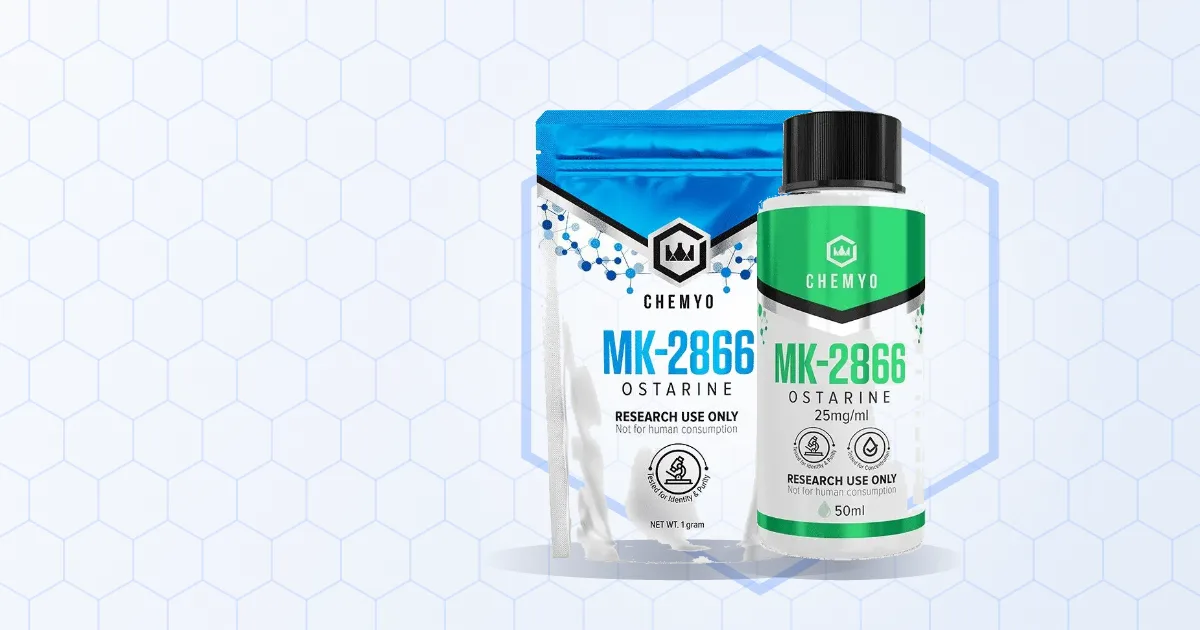
What is Ostarine MK-2866?
Ostarine, also called enobosarm and GTx-024, is a nonsteroidal selective androgen receptor modulator. The MK-2866 code comes from a period when Merck partnered with its developer. It binds the androgen receptor in muscle and bone and has much less effect on the prostate in animal models, which is the defining idea behind SARMs.
The CAS number is 841205-47-8, the formula is C19H14F3N3O3 and the molar mass is 389.33 g/mol.
Who developed enobosarm
GTx Inc., a company in Memphis, developed it out of SARM research at the University of Tennessee. That same program produced Andarine (S4) and S-23. Of the three, enobosarm went furthest by a long way.
What the Ostarine trials found
A Phase II trial in healthy older men and postmenopausal women found a dose-dependent increase in lean body mass over 12 weeks, along with better stair-climbing performance. A second Phase II trial in cancer patients with muscle wasting reported similar gains in lean mass.
GTx then ran two Phase III trials, called POWER 1 and POWER 2, in patients with non-small cell lung cancer. The results, announced in 2013, didn’t meet the endpoints the FDA had agreed to, and the compound wasn’t approved. It was later studied for breast cancer and for stress urinary incontinence, but it still has no approval anywhere.
Because of those trials, there’s more human safety data for enobosarm than for any other SARM. You can browse the papers on PubMed.
How tissue selectivity works
Testosterone acts on the androgen receptor everywhere it’s found: muscle, bone, skin, prostate and more. It can also be converted into DHT or estradiol, which spreads its effects further.
Enobosarm binds the same receptor but isn’t a steroid, so those conversions don’t happen in the same way. The receptor changes shape slightly differently depending on the molecule bound to it, and different tissues read that shape in different ways. In muscle, the signal is strong. In the prostate, it’s weaker.
That gap is what the Phase II trials were really testing. Lean mass went up. The expected androgen side effects were smaller than you’d see with testosterone. Smaller isn’t zero, though. The trials still recorded changes in hormone levels and blood lipids.
Why it’s on sports banned lists
All SARMs are prohibited in competitive sport, and Ostarine is the one that shows up most often in positive tests. A number of those cases were traced to contaminated supplements, which says a lot about how loosely some products are labeled. It’s one reason we publish our lab reports.
Ostarine compared with other SARMs
RAD-140 and LGD-4033 are more potent in the published data, but they have less human research behind them. Andarine S4 is a close relative from the same lab. OTR-AC is an acetate ester of Ostarine that some labs use for comparison work.
If you want a well-documented reference compound for a SARM study, this is usually the one to start with.
Planning research with enobosarm
Because there’s so much published data, you can often match your design to an existing paper. That makes it easier to compare your results with what’s already known.
Decide early whether you’ll work from powder or solution. Our solution is 25mg/ml in PEG 400, which is a higher concentration than most of our SARM solutions. Plan your measurements with that in mind, and keep a vehicle-only control. Write down the batch number on the label so you can match your data to the right certificate.
Working out concentrations
Our solution is 25mg/ml. Divide that by the molar mass, 389.33 g/mol, and you get about 64.2 mM. A 1 in 10 dilution brings it to roughly 6.4 mM. If you’re starting from the 1g powder instead, weighing 25mg into 1ml of solvent gets you to the same starting point.
Write the calculation into your protocol once. It’s a small step, and it stops errors from creeping in when someone else repeats the work.
What our lab report shows
The certificate for our Ostarine powder, batch BA2177, comes from an ISO/IEC 17025:2017 accredited lab. An FT-IR identity test came back positive, and HPLC measured purity at 99.1%. You’ll find it in the product’s image gallery, and our lab testing page explains how to read it.
How to buy Ostarine MK-2866 for research
Ostarine MK-2866 at Chemyo Labs
- Ostarine MK-2866 powder, 1g: $30, the lowest-priced SARM we sell.
- Ostarine MK-2866 solution, 25mg/ml, 50ml: $60, 2.5% MK-2866 in 97.5% PEG 400.
- Ostarine and Cardarine stack: $110, with a 1ml pipette.
- Ostarine and MK-677 stack: $130, with a 1ml pipette.
Everything above is in stock. If you’re measuring from a solution, our sterile 1ml droppers cost $1 each.
Ostarine MK-2866 questions
Is Ostarine the same as MK-2866 and enobosarm?
Yes. They’re three names for the same compound.
Has Ostarine been approved?
No. It reached Phase III trials but hasn’t been approved for any use.
Why is the powder so much cheaper than the solution?
The powder is 1g of dry compound. The solution holds 1.25g of Ostarine in 50ml of PEG 400, made up and bottled for you.
What is OTR-AC?
OTR-AC is Ostarine-O-acetate, an ester of Ostarine. We sell it as a 1g powder.
Ready to order? Buy Ostarine MK-2866 powder or the solution, or browse all SARMs for sale.
More research guides
MK-677 (ibutamoren): a research guide
What Merck found, how it works on the ghrelin receptor, and how to buy it as powder or liquid.
RAD-140 (testolone): a research guide
Radius Health’s SARM, the preclinical data and the Phase 1 trial, plus our two formats.
Cardarine GW-501516: a research guide
Why GSK dropped it, why labs still use it, and how it pairs with SARMs.
LGD-4033 (ligandrol): a research guide
Ligand’s SARM, the 2013 Phase I study and how our solution is made up.